One Minute Takeaway:
- — Why is hiring harder even with plenty of applicants? AI tools have made it easy for candidates to produce polished applications without any change in their underlying skills, which means resume quality is no longer a reliable indicator of capability.
- — What is the real problem? The signal has gotten weaker. When every application looks polished, hiring managers spend more time sorting than assessing, and strong candidates disengage before a decision gets made.
- — What should hiring managers do about it? Stop relying on resume polish as a filter. Add one evidence-based step to your process, define your must-haves before you post, and consider a recruiting partner who handles screening and verification upstream so your team can focus on the decisions that actually require their judgment.
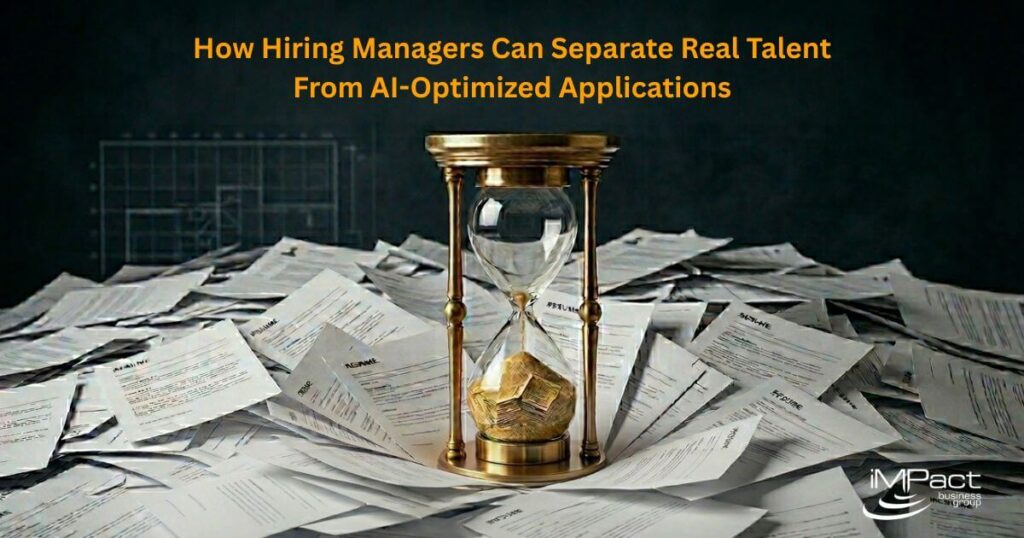
Hiring teams are not short on applicants right now. They are short on confidence in what those applications actually mean.
According to a Robert Half survey, 84% of HR leaders say AI-generated applications have increased their team’s workload, 65% say skills are harder to verify than they used to be, and 67% say AI resumes are actively slowing their hiring process down. About 20% report delays of roughly two weeks per role. That is time and capacity most hiring teams cannot afford to lose.
The central problem is not volume. It is that the signal has gotten weaker at exactly the moment when hiring decisions feel higher stakes. Skill gaps are real, teams are leaner, and the cost of a bad hire or a prolonged vacancy is higher than it used to be. When every application looks polished, hiring managers spend more time sorting than assessing, and strong candidates often disengage before a decision gets made.
This article is about what to do about that.
Why the Resume Stopped Being Reliable
For decades, a well-written resume was a reasonable proxy for candidate quality. That proxy is breaking down.
According to SHRM, an estimated 40% to 80% of applicants now use AI to write resumes, craft cover letters, or prepare for interviews. Recent research summarized by Wharton, based on over 5 million cover letters, found that candidates with access to generative AI produced stronger, better-tailored applications and landed more interviews without any change in their underlying skills.
More interviews. Same skills. The presentation improved. The capability did not.
What has emerged is a strange loop: AI screening tools evaluating content that was often created by AI. The resume, in many cases, has become a formatted document designed to pass a system rather than a genuine reflection of what someone can do.
The organizations responding most effectively are the ones that have stopped treating the resume as proof and started treating it as an introduction.
Why Skills-Based Hiring Often Sounds Better Than It Works
Most employers say they want to hire for skills. The difficulty is that most hiring processes still rely on signals that do not measure skills especially well.
A joint Harvard Business School and Burning Glass Institute study of more than 11,000 roles found that while many companies talk about skills-based hiring, they continue to screen in ways that privilege degrees, pedigree, and keyword alignment. The language changes. The habits do not.
For hiring managers, that gap is important. If the process still overweights resume wording and brand-name experience, a skills-first strategy is not fully operational. It is still filtered through old assumptions.
The fix is not complicated, but it does require intention. Treat the resume as a starting point. Build evaluation around what the role actually requires. Then find ways to see evidence of that capability before the final interview, not after.
Why Candidate Trust Matters More Than Most Teams Realize
AI is changing candidate behavior, but it is also changing candidate expectations. The gap between the two sides is wider than most hiring teams recognize.
In Greenhouse’s 2025 AI in Hiring Report, 70% of hiring managers said they trust AI to make faster and better hiring decisions. Only 8% of job seekers described AI-driven hiring as fair. Nearly half of U.S. job seekers said their trust in hiring declined over the past year, with 42% blaming AI directly.
When candidates feel they are moving through an opaque or overly automated process, engagement drops. Responsiveness slows. Offer acceptance rates suffer. The strongest hiring teams are not choosing between technology and human judgment. They are using technology to support a more thoughtful process, not replace it.
A process that feels fair and relevant to candidates is not just good ethics. It is a competitive advantage in a market where strong candidates have options.
The trust gap: employers vs. job seekers on AI hiring
70%
47%
42%
8%
Source: Greenhouse 2025 AI in Hiring Report
What Stronger Screening Actually Looks Like
The most effective screening processes define the role’s must-haves before recruiting begins, distinguish between requirements and preferences, and assess candidates consistently against those criteria. Most importantly, they bring evidence into the process earlier rather than relying on resume review alone.
In practice, that does not require a complete overhaul. A few targeted changes make a measurable difference:
- Send one role-specific question with the interview confirmation. Ask candidates to respond in two to three sentences before they arrive. It takes five minutes and immediately separates people who have thought about the role from those running a mass application campaign.
- Add a short work sample before the first interview. A brief exercise tied to a real task the role involves reveals capability that no resume can. It does not need to be elaborate to be effective.
- Build a simple scorecard before you post the role. List three to five must-haves and score every candidate against them consistently. It reduces deliberation, speeds up decisions, and keeps the process from drifting toward gut feel.
- Verify before you advance. If a candidate claims a specific skill or result, ask them to walk through it in detail. How they explain their own work tells you more than how their resume was written.
These steps also tend to improve speed. Better front-end clarity reduces unnecessary interviews, shortens deliberation, and makes it easier to move decisively when the right candidate appears.
Four steps to stronger screening
What a Good Shortlist Should Accomplish
A good shortlist should reduce complexity, not add to it. By the time candidates reach a hiring manager, several things should already be true:
- Their relevant experience is apparent and verified
- Their fit against the role’s priorities is clear
- Their level of interest is current
- Open questions are specific enough to test during the interview
Hiring managers do not need more information for its own sake. They need more confidence in the information they are given. In a crowded and AI-influenced market, that confidence comes from better screening logic, not just more candidate flow.
That is the case for a strong recruiting partnership. Not simply access to more candidates, but arriving at the interview stage already knowing who belongs in the room and why.
The Broader Skills Issue Behind the Noise
It is worth stepping back from the resume problem for a moment, because the hiring challenge runs deeper than application volume or AI optimization.
The World Economic Forum’s Future of Jobs Report 2025, based on surveys of over 1,000 employers covering more than 14 million workers, found that 63% of employers see skill gaps as the biggest barrier to business transformation through 2030, and 85% plan to prioritize upskilling to keep up. The capabilities most distinguishing growing roles from declining ones include resilience, flexibility, resource management, quality control, programming, and technological literacy.
Employers are not just trying to fill seats. They are trying to build teams with the right capabilities for a moving target. That makes every hire feel more consequential, and every weak process feel more costly.
Three Things Hiring Managers Can Do This Week
The problem is real, but it is also solvable. Here is where to start:
- Redefine what you are actually screening for. Before your next search opens, write down the three to five capabilities that genuinely predict success in the role. Not credentials. Not years of experience. Actual capabilities. Use those as your filter, not the resume.
- Add one evidence-based step to your current process. A short work sample, a pre-interview question, a skills verification conversation. Pick one. You do not need to rebuild the whole process to start getting better signal.
- Audit where your team’s time is going. If your hiring managers are spending most of their time sorting, verifying, and screening rather than evaluating and deciding, that is a process problem. A recruiting partner who handles that work upstream frees your team to focus on the decisions that actually require their judgment.
Hiring today is not defined by a lack of candidates. It is defined by a lack of clear signal. The organizations that navigate this well will be the ones that adjust their evaluation methods to match the market they are operating in. They will rely less on resume polish, more on evidence, and less on volume for its own sake.
Because in a market full of optimized applications, the real advantage is not access to more candidates. It is the ability to recognize the right one, faster and with more confidence.
Ready to Build a Better Shortlist?
If your hiring process is producing more uncertainty than confidence, the solution is not more applicants. It is better signal earlier in the process.
Some companies have the internal resources and bandwidth to build this capability themselves. Others benefit from partnering with specialists who do this work every day.
If you are facing urgent hiring needs, stretched internal teams, or roles that keep going unfilled, we would love to talk. Let’s discuss your hiring challenges and explore how we can help you find the right people faster.